Surreal Spiti.


By Mansee Shah.
Mansee travelled to Spiti on a trip organized by India Untravelled in June 2012, and is back to take us on a virtual journey around Spiti.
I travelled to Spiti in June 2012. I had not even heard of the place before I came across this site  http://indiauntravelled.com/trips.html, fell in love with a snap posted on it, and decided that I wanted to visit there. I checked with a few friends if they wanted to join, but unfortunately they could not, due to work / social engagements and the works. Anyways, the enchanting photograph was still in my mind and I decided to travel solo. Joined a trip organised by India Untravelled and had one of the most awesome experiences ever!
The beauty of Spiti lay in the diversity of the place – hard rocky terrain, gushing water, snow capped moutains, greenery (though in bits and pieces– otherwise it is rocky terrain) and the beautiful monasteries…all of it just awesome :) Surrounded by the Himalayas, you will find yourself seeing the varied beauty of the mountains while doing ordinary things like sipping tea, having lunch or just plain gazing.

Tying prayer flags in Spiti.

Interacting with the locals was so engaging – they are so hard working and yet so simple. I especially fell in love with our guide – Tsering, and this cute couple in a Dhaba.
The cutest couple at Chandra dhaba.
Some of the must visit places in Spiti are:
  • Kaza, a vibrant town which has a petrol pump at highest altitude levels.
  • Tabo, the most charming place in Spiti – be it the charming people, the 1000 year old Tabo monastery, the caves, the souvenir shops, everything is just heart tugging.
  • Dhankar, whose monastery is precariously perched on the mountains, and Dhankar lake.
  • Trip from Demul to Komic — if you are fit, its a moderate 4-5 hours trek. If you are unfit (like me :P ), then opt for a yak.
  • Komic, a charming village and homestay, also do send some postcards from the highest post office in Asia at Hikkim (close to Komic village)
Hiking back from Dhankar Lake.

Locking horns mountain goat.

The secret lives of the lamas (monks) of Spiti!


We missed out on Pin Valley and Chaandrataal lake due to landslides but pictures show they are extremely beautiful locations so definitely “must dos” if in Lahaul - Spiti Valley.
The best and the worst part about the trip was the journey. Worst because the road from Manali to Kaza is quite rocky and is not for the faint hearted who are used to travelling smooth. But if you do manage it, I can promise its the most awesome journey ever. You will always be worried about dozing off because you dont want to miss a single moment of natural exquisite beauty. Cannot describe it in words. Especially loved the Kumzum pass :)  There are some moments when the entire body is smiling and you feel just happiness and quiet joy within. I experienced that there :)

Enchanting times.


Go experience that you!
Author Bio: When she is not slumming it out at work, the author enjoys the good things in life - yummy food, appealing books, interesting movies, vivacious conversations, and of late, she has started to enjoy exploring various locations as well.  She writes sporadically at http://mansee-pov.blogspot.in/  and http://manseelikes.wordpress.com/ and tweets @ManseeT.
For more stories off the beaten path in India, visit www.indiauntravelled.com or join India Untravelled on Facebook and TwitterTo contribute guest posts / photo essays to this blog, please send your story ideas to shivya@indiauntravelled.com

Nathdwara: Exploring the Rajasthan of Temples.

By Hiren Busa.

Rajasthan is considered one of the most beautiful states in India, a state full of rich history and traditions. Rajasthan has some real gems like Jaipur, Udaipur, Jaisalmer, Mount Abu and Bikaner. I have had the pleasure of visiting many of these places and returning with fond memories. However I feel Nathdwara, a small town located near Udaipur, is relatively unexplored. I have been visiting the beautiful town of Nathdwara since I was a child, and have some of my favorite memories attached to this place.

Nathdwara, Udaipur, Rajasthan, Shrinathji, Nathdwara temple, Shrinathji temple


Nathdwara is most known for its Krishna temple, which houses the idol of ‘Shreenathji’. Nathdwara is also referred to as ‘Shreenathji’ by many people, getting its name from this idol of ‘Shreenathji’. It is believed that the famous Krishna temple was built in the 17th century in the exact location where the god ‘Shrinathji’ was born. Devotees from around the country visit this temple every year to get blessings from their favourite god. The temple is built with a very simple architecture, but its beauty is worth watching. The temple gates are opened 8 times a day for the devotees to view the idol of Shreenathji. The Vaishnav community visit Nathdwara during the festival of Diwali every year, to enjoy the different traditions and rituals of the place. The temple has more than 500 cows and nearly all of them are in display during the Diwali and Khekra celebrations.

Shrinathji Nathdwara, Shri Nathdwara, Shreenathji Nathdwara, Nathdwar


The idol of Shreenathji is decorated with different dresses throughout the day and is one of the main attractions to visit the temple. Thousands of people visit this temple every year and tight security is implemented to avoid any hazards. During festivals like Diwali, Holi and Navaratri, people from across the country come in large numbers to visit the town and the temple itself. Nathdwara may be a small town but is a great place for shopping different items related to Indian traditions. People love to buy Indian jewellery, saris, shreenathji idols and beautiful paintings from this small town.

We all are aware about the popularity of the Mumbai street food. Well, the street food in Nathdwara is equally popular among locals and travellers alike. I have had some amazing experiences whilst visiting the streets of Nathdwara and enjoying the different Indian delicacies. You can find some really tasty Indian dishes like jalebi, poha, pav bhaji and suran on the streets of Nathdwara. One piece of advice though, try them only if you have a stomach for street food.

Getting there: You have the option to reach Nathdwara by road, rail or air. The easiest way to get to Nathdwara from any major cities in India would be by Indian railways. Udaipur is the closest city to Nathdwara, and from there you can take a bus or a private car to reach Nathdwara within a couple of hours. While in Nathdwara, do visit Shreenathji Temple, Rakt-Talai, Charbhuja Temple and Gavshada.

So what are you waiting for? I would highly recommend a visit to this vibrant and religious place of Nathdwara to experience Indian culture and traditions.

Author Bio: The author works for Translation Services24.Ltd.

For more stories off the beaten path in India, visit www.indiauntravelled.com or join India Untravelled on Facebook and TwitterTo contribute guest posts / photo essays to this blog, please send your story ideas to shivya@indiauntravelled.com

Lahaul & Spiti: The Wilderness Beckons.

By Ashwin Sharma.

Ashwin takes us on a virtual trip to one of the most magnificent places in India - the high Himalayas of Spiti & Lahaul. Get in touch with us to organize a trip for you to this cold mountain desert.

Lahaul & Spiti are two separate places, but collectively form a district capable of mesmerizing anyone. Lahaul & Spiti is a valley which can leave you bewitched; the beauty of this place will make you pinch yourself to believe it’s no dream. It’s a pristine and primeval place, with a charm and charisma that even the heavens might refuse to offer.


Lahaul Spiti, Spiti, Spiti Himachal, mountains India, Himachal photos, Himalayas India
Spiti in winter.


The district of Lahaul-Spiti lie in the Indian state of Himachal Pradesh. The valley is adjacent to the Tibetan border and therefore resembles Tibet in more than many ways. Both words, Lahaul and Spiti, come from the Tibetan language. Lahaul means ‘southern country’, while Spiti means ‘middle country’, and these names perfectly define their location.

Lahaul, still untouched by mass tourism, gives a feel of time coming to a standstill. Situated on the Indo-Tibetan border along the Manali-Leh route, the region unveils its treasure of monasteries and countless number of streams and rivers. Spiti, famously known as "Little Tibet", is surrounded by mountains and glaciers, and abounds in monasteries, houses perched on mountain tops, and free flowing crystal clear rivers and streams. The valley is cut-off from other parts of the country in winter, and is practically accessible only in summer.


Lahaul Spiti, Spiti, Spiti Himachal, mountains India, Himachal photos, Himalayas India
Buddhism in Spiti.


Places to visit in Lahaul & Spiti:

Rohtang Pass: Rohtang literally means pile of dead bodies, and is not a very high pass at 3900m. It is the first pass at the beginning of Lahaul-Spiti, and sets the tone for what's to come.

Key Monastery: Key monastery holds a powerful sway over the buddhist population in the state, and is one of the favourites of His Holiness the Dalai Lama.

Kunzum Pass: The main access point to the Spiti valley from Lahaul, which is separated from Spiti by the Kunzum range.

Kaza: Kaza is where the administrative headquarters of Spiti are located. The town has a measly population.


Lahaul Spiti, Spiti, Spiti Himachal, mountains India, Himachal photos, Himalayas India
Spiti River.


Kibber: It’s a small village but a blue water lake named Tso Moriri is not very far from it, so it is a place to stay for adventurists going on Tso Moriri trek.

Keylong: Keylong is the district headquarter of Lahaul & Spiti. This town is the commercial center of Lahaul & Spiti, and the only town in district where you have access to urban amenities.

Sarchu: It is a town about 100kms from Keylong. Most of the tourists traveling to Leh stay in Sarchu, though most of the accommodations are tented ones. Sarchu is at an altitude of 4300m, and because of the height many people feel the symptoms of altitude sickness.


Sarchu, Lahaul, Himalayas India, mountains India, Himachal photos, Lahul
Sarchu.


Dhankar Monastery: This monastery is around 20 kms from Kaza, in the eastern part of Spiti. The village has a fort perched on top of a hill. The monastery is old and important.

Chandrataal: This is where the Chandra river originates. It’s a beautiful lake and is near to Kunzum Pass. Chandrataal is frequented by tourists during summer, and it’s as picturesque as a lake can be.

Suraj Taal: This beautiful lake lies near the very famous Bara-lacha La. It is at a height of around 5000 m . River Bhaga originates from this place. This lake is perfect for camping, away from all the crowds, in god’s own territory.

Author Bio: Ashwin Sharma is a travel blogger, currently working with Cheapoair.com. 

To plan & book a trip to Lahaul - Spiti, email us at shivya@indiauntravelled.com.

For more stories off the beaten path in India, visit www.indiauntravelled.com or join India Untravelled on Facebook and TwitterTo contribute guest posts / photo essays to this blog, please send your story ideas to shivya@indiauntravelled.com


Kalmungda Village: Life by the Indian Ocean.


By John Pothala.

A random encounter led me to some of the most untouched waters in India, while I was on a dream ride to explore India and Nepal.

Following a hearty breakfast of Biryani at Padukkotai (that’s right, you can find biryani at 10 am on the coast of Tamil Nadu), I head out onto the east coast road eager to reach Rameshwaram, which is 280 kms away. 30 minutes into the ride, I catch my first glimpse of the ocean after Pondicherry. A huge fan of the ocean, I decide to get down and shoot some footage, when suddenly kids from the few huts that make up a village come out to investigate, followed by a couple of fishermen. 

Tamil Nadu villages, South India, India villages, rural India
The kids of Kalmugnda Fishing village.

I talk to them in English / Hindi / sign laguage, whichever works, and they offer to take me out into the middle of the ocean for 100 rupees worth of diesel. I immediately say yes! Before I know it, I’m crossing a swamp to a really authentic looking fishing boat, and heading out to sea with 7 other fishermen. 70 minutes on, we come across a huge log which came in from Sir lanka during the Tsunami. Marimutth, the man who seems to be in-charge, tells me that we are 17 kms from Sri Lanka, and that the log is stuck on a submerged island. The fishermen start insisting that I dive first, so I throw off my shirt and take the plunge, Johnny Depp style.

Indian Ocean, India images, villages of India, village life in India
The submerged Island Log.

Rural India, rural life in India, India images
Weighing anchor, notice the depth here?

South India, Southern India, Indian Ocean, village life in India
Diving into the Indian Ocean.


I don’t remember  many times that I’ve forgotten everything else in the world, but sitting in knee deep water on a submerged island in the middle of an ocean can do wonders; I can’t help but  forget everything and smile.  Marimutth and the other fishermen seemingly happy with my presence, jump in and take me over to the log. I try to climb on top but get gashes on my toes from all the coral on the surface, to which Marimutth says no problem, and starts rubbing deep into the wound. ‘No tension, salt do magic, no tension, full relax’ he says, and starts commenting on how delicate us city boys are and how he had an iron body. I laugh with him and jump back into the water. My new friends and I spend over an hour there relaxing and playing with the occasional crab. It is an experience that I will remember as the most peaceful of my life. I wonder what city life and my IT job have done to me, so much that as a bachelor at 24, I’m starting to feel so strongly about peace and tension. Good thing I quit my job and bought an Enfield.

Rural India, rural life in India, village life in India, India villages
Trying my hand at navigating the fishing boat. 

Tamil Nadu villages, India images
17 km from Sri Lanka, this log.

On the away back to land, Marimutth tells me that I am the first outsider to come to this village in years. That doesn’t surprise me too much, given how everyone looked at me the way you’d look at a plane if it was parked somewhere it shouldn’t be. I am invited for drinks and fish back on land. No way can I say no to that, so the guys take me to one of the ponds where people bathe; every village along the coast of Tamil Nadu has a couple of these ponds. Refreshed and clean, I go apply some Betadine on my toes and head over to party with the fishermen and spend the night sleeping under the stars. I ride only 20 kms that day.

South India, rural India, life in India
My faithful enfield parked in Kalmungda.

Getting there: Take the ECR from Pondicherry, toward Adiramapatanam, which is 200 kms away. Upon reaching ask for directions to Kalmungda village.

Author Bio: The author is 24 and hails from Hyderabad. In February 2012, he quit his job as a salesman for a major IT company, to go out and explore life. His first adventure started on 4th March 2012, and took him and his bike 13,000 kms around India and Nepal. Follow his journey on www.indiabybike.com.

For more stories off the beaten path in India, visit www.indiauntravelled.com or join India Untravelled on Facebook and TwitterTo contribute guest posts / photo essays to this blog, please send your story ideas to shivya@indiauntravelled.com


Tabo: An Alternative Guide.

By Aditi Rao.

Aditi travelled on an India Untravelled trip to the high Himalayas of Spiti, and is back to take us on a virtual journey along Tabo monastery, which dates back over a 1000 years.

If the monastery at Tabo is a checkmark on your to-do list, listen to the guides, and go there at 9 AM, when the gods are ready to meet the tourists.
If you want to catch the gods when they are more at ease, ignore your guide, and go there at sunset. The temples will be locked, sure, but the gods are around, relaxing after a long day of meeting with pilgrims and tourists. They have time to chat.
Tabo, Spiti valley, Tabo Spiti, Spiti
The monastery at Tabo, minus the people
It doesn’t matter if this is your first day in Tabo; you can’t not find the gorgeous mud structures. There is no way not to notice the piles of engraved rocks — no way not to know that this spot, with its broken wall and open gate, is sacred.
Once inside, close your eyes. Listen to the river gurgling in the distance, the birds who know to keep their chatter to a respectful volume. Open your eyes, and watch the mud temples and walls against the crystal sky. Watch the sky tracing the outlines of the larger mud walls, the mountains in the distance. Breathe in the prayers of a millennium.
Tabo monastery, Buddhist monasteries in India, monastery in India, Tibetan Buddhist temple
Carvings around one of the temple doors in the monastery.

That might be the most important thing — breathe deeply. You will need that air later.
If you are there to ask the gods for favors, I won’t promise that they will answer. They are off duty (would you pick up a client’s call at midnight?). But if you are there for conversation, there to listen to the secrets they have been keeping for a thousand years, there for friendship rather than for favors, I’m willing to bet you will not be disappointed.
Tabo Gompa, Spiti, Spiti Ecosphere, Tabo village
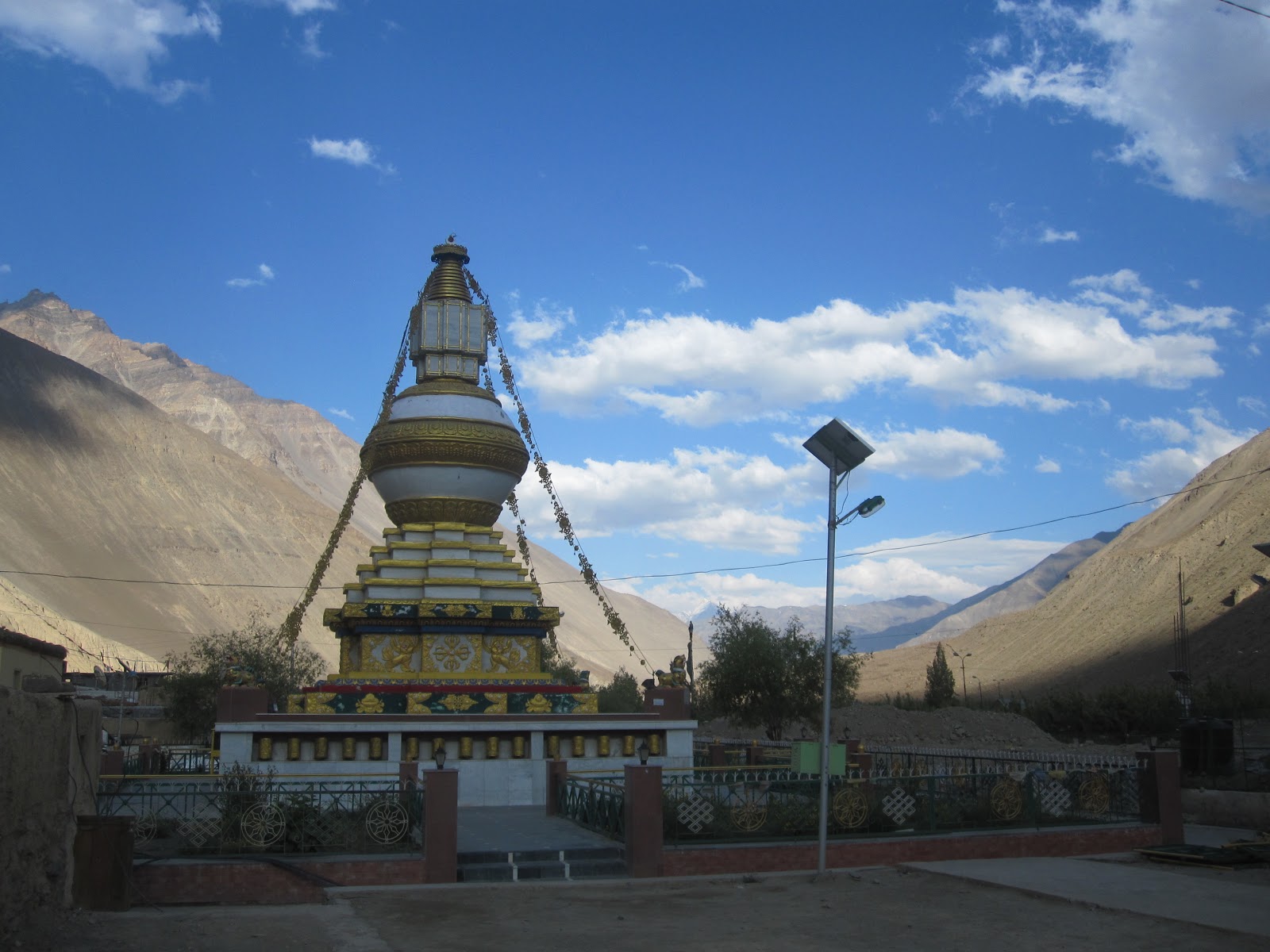
The main stupa in Tabo.

The locals tell me that one must walk clockwise through this monastery. I trust them on that — you probably should too. All the same, the first time I went in, no one had told me yet to move clockwise, and so I didn’t. I moved from structure to structure, as they called out to me, beckoned me over. I ran my hands over the engravings on the doors, and I sat down to write outside the temple of the mother goddess. I had my back to her, and I wondered briefly how she felt about that, but ultimately, she didn’t seem to care. She knew I meant no disrespect. I was there for love, for friendship, and I think she understood that. I think that meant more to her than did the direction in which I walked or faced.
Tabo village, Tabo farms, Tabo spiti, Spiti valley
A family from Shimla comes up every summer to cultivate these fields of green peas in Tabo.

As you walk out, stop by the shops. The shopkeepers, who have been just as busy with tourists all day as the gods have been, have time to talk in the evening. Let them tell you about what brought them to this town — or what leads them away from this town every winter and brings them back every spring. Let them tell you about another god and where you can meet him, April to October, for a week at a time (it doesn’t matter if you don’t want to meet him — it’s good to know anyway). Let one of them invite you home for tea or sell you a scarf for your mother. Let them explain to you the flags that tourists will buy. Let them give you the stories that cannot be bought.
Walk to the river. Get lost. Let a farmer tell you which way to go, allow you a shortcut through her fields. Let yourself get more lost in those fields when she disappears before you’ve found your way. Accept the slosh of your shoes wading through just-irrigated fields. Stretch your arms into a T, learn to balance on the narrow raised ledges crisscrossing through the fields. Find your way through the barbed wire, back at the mud structures.
Spiti, Spiti valley, Tabo, Tabo Spiti
Green relief against the desert's starkness.

Go into the monastery one more time. If you’re lucky, it is now dark enough for the stars. If you’re really lucky, there is no moon, and the stars have free reign of this particular night. Walk through the monastery again, this time by starlight. Walk silently — the gods are probably asleep, and so is most of the town.
Relish being awake and alive amongst resting gods. It may be the closest you ever come to godness.
Spiti wildlife
Birds against a crystal sky.

Author Bio: The author is a writer, educator, and dreamer. She currently works in New Delhi, blogs at http://aditirao.net, and lives everywhere she can.

For more stories off the beaten path in India, visit www.indiauntravelled.com or join India Untravelled on Facebook and TwitterTo contribute guest posts / photo essays to this blog, please send your story ideas to shivya@indiauntravelled.com